
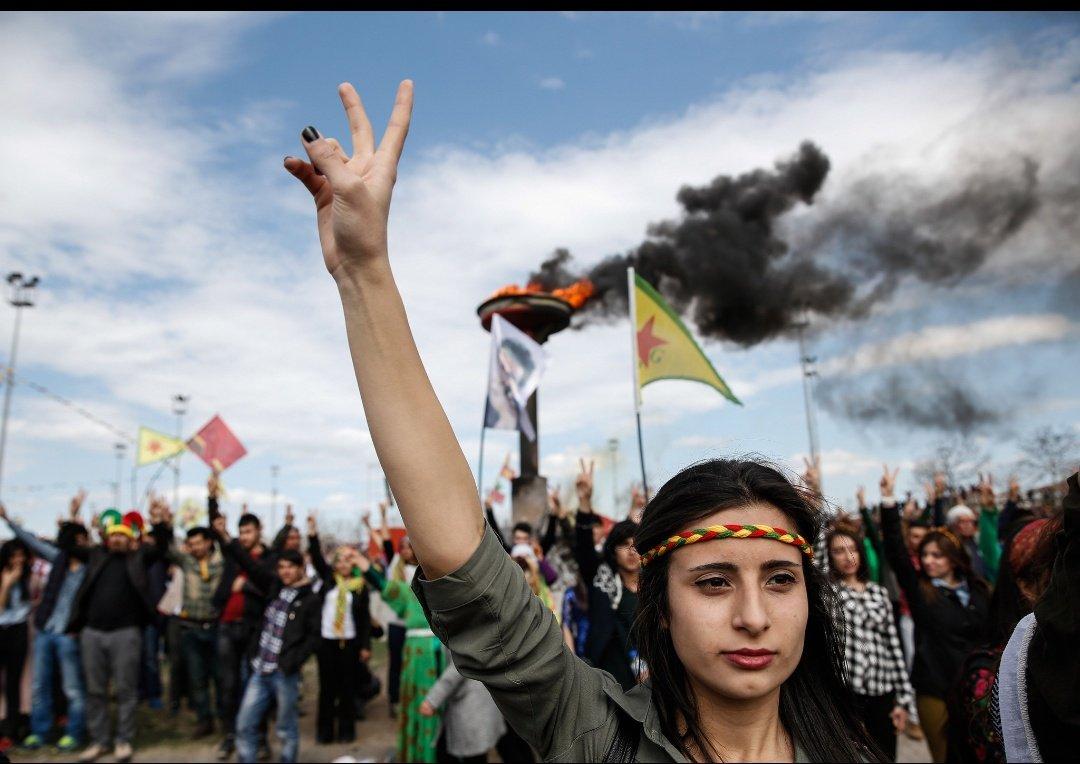
Massive assault on Rojava, siege of Kobanê, general mobilization, and a war threatening the very existence of the revolution. Rojava is in grave danger. But what exactly is the Rojava Revolution, and why do we call it a revolution? Why a women’s revolution? What are its achievements, and what can we, as internationalist youth, do about it? This article aims to answer these questions. It introduces the Rojava Revolution, its gains and achievements, and explains why they must be defended at all costs!
Kurdistan and Rojava
The Kurdish people number between 35 and 40 million. They are spread across their homeland of Kurdistan and in diasporas around the world. “Kurdistan” translates to “Land of the Kurds.” After the collapse of the Ottoman Empire, colonial powers divided Kurdistan into four parts: Bakur (North), Başûr (South), Rojhilat (East), and Rojava (West). These regions fall within the borders of Turkey, Iraq, Iran, and Syria. The Kurds remain the world’s largest stateless nation. In every part of Kurdistan, the Kurdish people face oppression and exclusion.
Bakurê Kurdistanê, the largest section, is occupied by the fascist Turkish state through military and police force. From the Dersim Massacre in 1937 to the Roboski Massacre in 2011 and attacks on Amed in 2015: hundreds of thousands of Kurds have been killed by the Turkish state, villages destroyed, and Kurdish identity denied and suppressed. Tens of thousands of political prisoners languish in the fascist Turkish state’s prisons, including journalists, leftist politicians, elected mayors, and revolutionaries. The state blocks any attempt at organisation through forced trusteeships – elected mayors are removed and replaced with appointed trustees, accompanied by bans on organisations and massive repression. In 2016, for example, parliamentary immunity was lifted for deputies of the pro-Kurdish HDP (Peoples’ Democratic Party), leading to the imprisonment of dozens of politicians. Meanwhile, assembly bans and curfews allow the military to be unleashed on protesters.
In Başûrê Kurdistanê, the southern part in Iraq, Kurds endured decades of oppression. Under Saddam Hussein, the Anfal genocide from 1986 to 1989 killed up to 182,000 Kurds, even poison gas was amongst the brutal killing methods. Since 1992, Başûr has had autonomous status within Iraq, but it is ruled by the Barzani family, which openly collaborates with the fascist Turkish state.
In Rojhilatê Kurdistanê, Kurds face assimilation policies by the Iranian state. Kurdish language, culture, and identity are officially denied and suppressed. Kurdish politicians, activists, and revolutionaries are imprisoned or abducted.
Rojava, the smallest of the four parts, is home to about 2 million Kurds in northern Syria. For decades under the Ba’ath regime, Kurdish culture was unrecognized and suppressed, the language banned. 300,000 Kurds were stripped of citizenship, and through colonial settlement policies Kurdish areas were arabized and isolated. Rojava long served as a refuge for PKK guerrillas, fostering an underground Kurdish organisation. In the early 2000s, parties and organisations emerged seeking autonomy for Kurds in Syria. Then, in 2011, the Arab Spring shook the reactionary bourgeois states of the Arab world, sparking uprisings against the Ba’ath regime in Syria. That spark reached Rojava and ignited a revolutionary process.
From spark to revolution: The birth of the Rojava Revolution
On December 17, 2010, the self-immolation of Tunisian street vendor Mohamed Bouazizi – sparked by police violence and humiliation – unleashed waves of protests that became known as the “Arab Spring.” Mass demonstrations erupted against Ben Ali’s corrupt, repressive regime, poverty, and police brutality. The protests spread across the Arab world and reached Syria in 2011, with months of demonstrations against the Ba’ath regime brutally crushed, eventually spiraling into civil war. The Ba’ath regime’s grip began to crumble.
Amid this loss of hegemony, the Kurdish people seized a historic opportunity. On July 19–20, 2012, they took power. The Syrian army and state administration were first driven out of Kobanê, followed shortly by Afrin. The People’s Defense Units (YPG) and the Movement for a Democratic Society (TEV-DEM), founded in 2011, now assumed control. From that moment, the building of democratic self-administration began. Society organized itself through councils and communes. In April 2013, the Women’s Defense Units (YPJ) were established. The revolution spread, liberating Serê Kaniyê from the jihadist Al-Nusra Front in July 2013. In 2014, the cantons of Cizîrê, Afrin, and Kobanê declared official autonomy, forming Rojava. At that point, the three cantons were still geographically separated by jihadist and militia presence.
In 2015, the Syrian Democratic Forces (SDF) and the Syrian Democratic Council were founded. The revolution increasingly became a “revolution of the peoples.” In 2016, the peoples of North-East Syria united to establish the Autonomous Administration of North and East Syria.
Victorious against ISIS
From the start, the young revolution faced extreme attacks. In 2014, the so-called Islamic State (ISIS) surged in the region. On August 3, ISIS began a genocide against the Yazidis in Shengal, murdering tens of thousands. Thousands of Yazidi women were enslaved, abducted, and raped. ISIS barbarity unfolded before the world’s eyes. The YPG and YPJ, along with fighters from the MLKP (Marxist-Leninist Communist Party of Turkey and Kurdistan), opened a humanitarian corridor to allow Yazidis to escape to Rojava. The mission succeeded, saving thousands from genocide.
In September 2014, ISIS – evidently with support from the fascist Turkish state – launched a direct assault on the revolution and the canton of Kobanê. YPG, YPJ, and their allies fought fiercely for the city where the revolution had erupted two years earlier. Residents from surrounding villages were evacuated amid fears of massacres; many fled. ISIS attacked with tens of thousands of fighters, encircling Kobanê. A brutal house-to-house battle ensued. Kobanê drew global attention: German television broadcast reports of the Kurds’ fight against ISIS, and worldwide millions took to the streets. In Bakur and Turkey, uprisings erupted, with thousands storming the border to reach Kobanê. The Battle of Kobanê became the Stalingrad of the 21st century: through determined street fighting, YPG, YPJ, and allies liberated the city. The YPJ’s resistance, in particular, entered history, with dozens sacrificing themselves to avenge their sisters in Shengal. This liberation would not have without U.S. airstrikes. The Rojava Revolution entered a tactical alliance with U.S. imperialism to defeat ISIS and preserve the revolution. The heroic struggle for Kobanê symbolized humanity’s victory over barbarism and marked the beginning of ISIS’s downfall. Thousands of fighters gave their lives there. Building on this, revolutionary forces liberated Manbij, Tabqa, and Raqqa from ISIS, halting it for good. Rojava became a bastion against reaction – whether jihadist or from bourgeois-reactionary states in the region.
The fascist Turkish state and its plans for annihilation
In 2018, the fascist Turkish state, backed by jihadist militias, attacked the Kurdish city of Afrin in North-West Syria. Afrin was occupied, forcing hundreds of thousands of Kurds to flee. Soon after came occupations of Serê Kaniyê and Tel Abyad, displacing hundreds of thousands more. The fascist Turkish state launched open war against the revolution, carrying out targeted drone strikes on its leaders. Communist MLKP commanders Baran Serhad and Zeki Gürbüz, specialist Özgür Namlıoğlu, and dozens more were assassinated by Turkish drones. The fascist Turkish state aims to eradicate all Kurdish achievements, waging war in Başûr, Bakur, and Rojava. It seeks to colonize Kurdish lands and annihilate the Kurdish people’s existence. To this end, it collaborates shamelessly with jihadists and other reactionary forces, employing every military means—from drone warfare and chemical attacks to the deliberate destruction of critical infrastructure. Beyond military efforts, it pursues targeted settlement policies in occupied areas, displacing Kurds and destroying their villages while settling other groups.
Why call it a (women’s) revolution in Rojava?
Revolutions come in different forms. A political revolution transfers power from one ruling class to the oppressed. The working class and oppressed smash the old state apparatus and build a new one. Social revolutions shift from one mode of production (how production is organized and the relations people enter into) to another, when productive forces (knowledge, labor, technology, resources, etc.) reach a level that contradicts the old mode, demanding a new one for societal progress. National revolutions break colonial domination, freeing a nation from colonial oppression.
In Rojava, we see a democratic revolution. The Kurdish people liberated themselves from colonial oppression by the Ba’ath regime and Syrian state. It has a democratic character because it expelled the old Ba’ath state apparatus and built a new, democratic, people-centered system based on defense by YPG and YPJ – the People’s and Women’s Defense Units – and organized in councils and communes. Power lies with the working and oppressed masses, giving it a tendency toward social liberation. The revolution’s main carriers are the people’s councils, making it deeply people-oriented. It transcends its national character to become a “revolution of the peoples,” where all nations and faiths are equal and share in governance. Its goal is to spread across the entire Middle East.
The women’s revolution
The revolution’s progressive character shines brightest in women’s liberation. Women organize autonomously at every level of society, from the smallest commune to the highest council. Women’s decisions are binding for all councils. The co-chair system ensures every leadership position includes at least one woman. Women defend themselves through the YPJ and autonomous security units. Women’s houses and women’s courts have created a legal system where women combat patriarchal violence and build their own justice. Men’s domination is challenged through women’s material power, institutionalized in structures, law, and organisation. In Rojava, male-dominated systems are fought ideologically and politically at every level.
All these achievements make Rojava a revolution of the 21st century – one unfolding in an era when bourgeois states proclaimed the final triumph of capitalism. Today, Rojava’s democratic women’s revolution proves that working and oppressed masses worldwide can still resist, seize power, and build revolutionary people’s democracy. It shows that revolutions remain possible. Rojava has become a beacon of hope for the oppressed and exploited everywhere.
Long live proletarian internationalism!
The Rojava Revolution’s magnetic pull has drawn in the oppressed and exploited. It has become an internationalist revolution, with people from hundreds of nations fighting in its ranks for freedom against reaction. Revolutionaries like Ivana Hoffmann – a German-Togolese woman – or Özgür Namlıoğlu – who traveled from Germany to Rojava – gave their lives for it. They recognized that this revolution has become humanity’s spearhead in the fight against reaction, barbarism, and imperialism. An International Freedom Battalion formed in Rojava to defend it, where thousands of internationalists gained combat experience and laid foundations for an anti-imperialist, antifascist, and antipatriarchal base for the global revolutionary movement. All along, Rojava has faced reactionary attacks: resisting them embodies proletarian internationalism today, bringing the call “Workers and oppressed of the world, unite!” into the 21st century.
An existential war threatens our revolution!
The Rojava Revolution faces existential danger. Since January 2026, fascist HTS (Hay’at Tahrir al-Sham) gangs and dozens of other reactionary militias have attacked the Autonomous Administration of North-East Syria. It began with assaults on Kurdish neighborhoods in northern Aleppo and escalated into a full-scale offensive against the revolution. The Syrian transitional government under Al-Sharaa – formerly Al-Jolani, once an Al-Qaeda leader – has allied with the fascist Turkish state to crush the revolution once and for all. Al-Sharaa toppled the Assad regime in December 2024 and now serves U.S. imperialist interests in the region. He has been welcomed in the White House, the Chancellery, Downing Street, and the Hôtel Matignon in Paris. The EU signed a 690-million-euro deal with him. Behind these attacks lies a plot by Western imperialists, eyeing trade routes from Israel to Turkey and the region’s resources – especially oil and gas. They aim to strengthen U.S. dominance, isolate Russian and Chinese influence, and eliminate the revolution, which remains a thorn in their side. The fascist Turkish state wants to complete its colonial project and destroy Kurdish achievements. Not since ISIS’s rise has the revolution faced such an existential threat. Kobanê is encircled and besieged, without electricity or running water for days. Food is running out, and children have already frozen to death. This is about the revolution’s sheer survival – a revolution of hope, of women, of peoples; one that smashed ISIS; one where the peoples of North and East Syria live in peace and people’s democracy; one that has produced thousands of martyrs and is carried by the oppressed and exploited worldwide.
The revolution resists – let’s do the same!
Even as these reports sound crushing, they reveal the revolution’s explosive power once again. With the general mobilization, people from all four parts of Kurdistan are heading to defend it. Images and videos show people tearing down border fences and confronting the Turkish military. Footage captures determined SDF, YPG, and YPJ fighters preparing for the existential battle to save the revolution. Young and old alike are arming themselves to protect their revolution and its gains. The revolution is gearing up for a war of existence – and it declares: I was, I am, and I will be.
At the same time, people in Europe are making their way to Kobanê to defend it. In countless European cities, thousands take to the streets in solidarity, showing that the revolution is defended even in the heart of imperialism. As internationalist youth, it is our task to become part of defending the Rojava Revolution. Our task is to keep the beacon of the oppressed and exploited burning. We must overcome our borders and wage resistance against imperialism here too. To do so, we must sharpen our practice, get creative, and use every means at our disposal to defend the revolution.
Long live the Rojava Revolution!
Long live the resistance of the oppressed!
Up with international solidarity!
Jin Jiyan Azadî! (Women, Life, Freedom!)