
It’s been more than three weeks since the US and Israel launched a major military attack
on Iran and killed its Supreme Leader Khamenei. Unlike the attack on Venezuela and the
imprisonment of Maduro, they were not able to reach their goal – in this case particularly
the control over the country’s oil reserves – by night. A long-expected war has escalated.
In the last days, a discussion in the revolutionary left of Germany evolved around the
question of a revolutionary stance towards the war. This article aims to comment on the
discussion as well as to give orientation for a revolutionary practice for european youth
against the imperialist war.
The US-Israel war on Iran did not start three weeks ago
The February 28 attack on Iran was no surprise. It was the continuity of a long-term Middle
East strategy which found its peak in the fast developments of the last weeks and days.
Since October 7 2023 it was clear that US imperialism and its most important “partner” in
the Middle East, the Zionist state of Israel, had no plan of “protecting Israel from
Palestinian terrorism” but rather took this day as the starting point of a new phase of
recomposition of the Middle East. Their plan was to encircle Iran, make the Iranian regime
fall and bring the entire Middle East under the hegemony of US imperialism. For this
reason they want to disarm and liquidate all powers which could cross their plans, from
revolutionary to bourgeois national powers, particularly Iran as the central enemy power to
the USA and Israel in the Middle East.
The first step was to destroy Iran’s Shia alliance starting from Hamas in Palestine,
continuing with Hezbollah in Lebanon. Only a few days after the biggest strikes on
Hezbollah in Lebanon, HTS marched through Syria and took the power while Assad fled
the country instantly. That was the end of 2024 when Trump came to power again (no, US
wars in the Middle East did not start with Trump, neither this particular war started with
Trump). In March 2025 the Self-Administration of Northeast Syria came to an agreement of
integration with the new Syrian regime. But its points were never implemented. This
agreement mainly aimed at gaining time for both sides to rearrange themselves for the
upcoming times, as the two powers stand antagonistically to each other.
In April 2025, the US and Iran started nuclear peace talks after a letter from Trump to
Khamenei. As the US wanted to seize control over the nuclear capacities of Iran, the
negotiations failed and this failure was responded to by attacks from Israel and the
12-days-war between Iran and Israel.
Whilst the direct war with Iran was stopped after a few days, Israel’s genocide in Palestine
continues in the most cruel way.
Ends of 2025/beginning of 2026, US diplomats tried to convince the Self-Administration of
Northeast Syria to attack the pro-Iranian Hashd al-Shaabi militia in Iraq which could have
meant a complete US-hegemony around Iran; but they failed as the Self-Administration did
not accept to fight someone else’s war.
On January 6 2026, at a meeting in Paris, the imperialists and the islamist fascist HTS
decided on the future of Syria. The HTS had to give control over the south of Syria to
Israel – in exchange, they were free to attack the Self-Administration of Northeast Syria,
and they did. Despite the heroic resistance of the Self-Administration of Northeast Syria
and the people of Rojava defending their revolution, large parts of the territory fell into the
hands of the HTS troops. Even if there is a new agreement of integration, the future of the
revolution and particularly of the women’s revolution is uncertain.
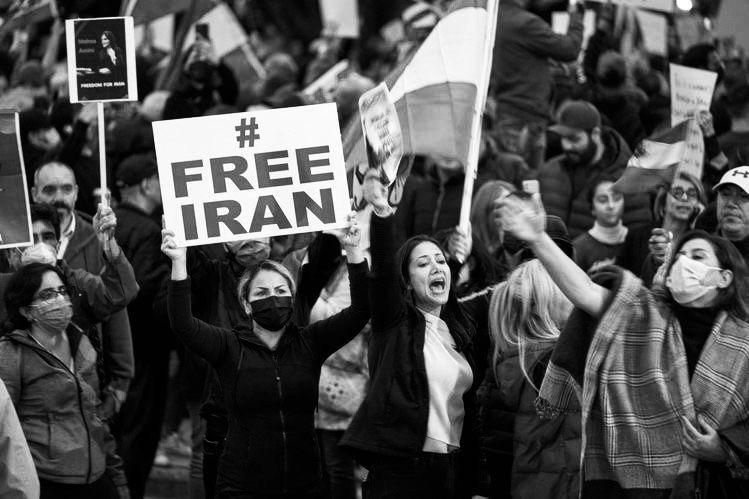
A few days earlier, in the very beginning of January, a people’s uprising in Iran started
which focused on poverty but also embraced the calls for democracy and women’s
liberation in Iran. First, Trump said that “help is on the way” and sent military boats, then
he engaged in nuclear peace talks again – only to go to these talks with the same total
demands which were clear to be unacceptable for Iran. Meanwhile, outside the Munich
Security Conference, thousands of Iranian monarchists were mobilized to stage the Shah’s
son Pahlavi as the new ruler of Iran. When the nuclear peace talks were about to “fail”, the
turning point, the “reason” for the war on Iran had come. This is not the work of “a crazy
man in the Oval Office”, this is the consequence of an aggressive imperialist strategy.
Whilst the USA mainly aims at weakening Iran as an opposing political power and
particularly gaining control of the country’s oil, Israel wants to totally destroy the state and
its regime. The people’s uprising in January was seen as the right moment to intervene
and push the people to overthrow the regime, to install a new one which serves US-/Israeli
interests. But the last weeks of war have shown that the case of Iran was not as easy as
they calculated.
This Middle East strategy also has to be understood as part of a broader offensive of the
bourgeoisie and the imperialist powers against revolutionary centres all over the world,
from the Philippines to India, Latin America, Palestine and Kurdistan and all centres of
opposition to the imperialist policies. They want to liquidate all resistance and all
counter-forces in preparation for a new World War, for a new period.
Solidarity with the Islamic Republic of Iran?
During the uprising in Iran, solidarity protests with the rising people of Iran took place in
various countries of the world. Jin Jiyan Azadi as a slogan of the revolutionary and the
grassroot movement echoed in the world. While the people were legitimately fighting for a
life in dignity, some organizations took very interesting stances in the name of
“anti-imperialism”. In their statement “Solidarity with the Iranian Islamic Republic!” the
Communist Organization (KO) from Germany stated:
“The communist movement in Germany almost unisono wishes success to the
uprisings in destroying the Iranian state. But before you support that, you have to
pose the question of what realistically could follow the Islamic Republic. And that is
the Syria-scenario (…)”
If there is oppression, then a fight of the people against this oppression will always be
legitimate. Of course, imperialist powers will try to take advantage of the class struggles in
the world. And many times in history, they really succeeded and they turned progressive
movements around. But this cannot directly lead to the conclusion that the imperialists’
plans are the only determining factor in history. Lenin did not say “if the Tsar regime falls,
our country will fall into the hands of European imperialism, for this reason I will not make it
fall” – he organized the revolution which made the regime fall and took over the power. If
we do not defend the calls of the people for freedom – then what do we defend as
communists?
It is true that the future of Iran and of the entire Middle East is not clear and full of risks.
If the US and Israel win this war, they are close to taking control over the entire region and
a huge step closer to the next World War. But on the other hand, the people of Iran are not
struggling for US interests, they are struggling for their own interests and most legitimate
demands. That is the Syria-scenario: The Arab Spring was a movement of peoples fighting
for freedom which showed the weakness of the oppressive capitalist states. Particularly
Syria was shaken by the power of the people. Soon after imperialists intervened, and it
turned into something else: Thousands of islamist militias intervened from various
countries, partly backed and financiated by western imperialist and zionist intelligences. In
a situation of uncertainty and power vacuum, when the hegemony of the Assad regime
was cracked, the Kurdish people took upon arms and built up their own administration,
their own power. But if an oppressed people is denied their rights, why shouldn’t they take
these rights themselves, relying on their own power and profiting from the contradictions of
the imperialist and regional powers? And if the oppressed do not fill the power vacuum,
hasn’t history shown that there are other forces who will come to do so (such as the
Islamic State)?
We know that throughout the last more than ten years there have been voices in the
working class left condemning the revolution of Rojava as a puppet of US-imperialism.
There have been currents inside the self-administration which relied on the imperialists as
there have been bourgeois national currents inside the revolution. But at least the
developments of the last weeks should make everybody who judges that easily become
quiet: The real puppet of US-imperialism is the HTS militia and the imperialists support
them while they are massacring the kurdish and other peoples. Rojava has shown a heroic
resistance with thousands of martyrs and is right now trying to profit from the instability of
the imperialist relations on the ground of diplomacy, as there is no international force
defending their gains against the HTS aggression, a puppet of US-imperialism. Rojava
shows that the oppressed can gain power – but it also shows that politics and war are dirty
businesses and that a revolution has to fight every day in order not to be crushed and
transformed into an imperialist project.
The Antifa Youth Aachen, part of the Red Youth of Germany, says in their statement
“Solidarity with the Islamic Republic of Iran”:
“The Iranian proletariat and parts of the labouring people’s masses of Iran stand in a
strong contradiction to the ruling bureaucratic capitalist class, but this is of minor
importance regarding the main contradiction between western imperialism and the
peoples of Iran.”
We may have learned to distinguish between main and minor contradictions in our marxist
books, but reality takes place outside of theory, in real life. It is true that the Islamic
Republic of Iran is mobilising masses of people for the defense against the imperialist war
right now. But this does not rule out the fact that for years now there have been various
uprisings of the people of Iran fighting against this repressive reactionary capitalist regime
which is the primary oppressor of women and of the various peoples who live in Iran. This
regime is hostile to people. The fact that the imperialist war on Iran is the main
contradiction in the moment does not directly lead to the conclusion of solidarity with the
regime – it leads to the conclusion to fight against this imperialist war, which is not in the
interest of the oppressed people of Iran.
In short: The imperialist attack of the USA and Israel on Iran is like an attack of a big
slave-owner with 100 slaves on a small slave-owner with 10 slaves. His goal is not the
liberation of the slaves, but to become owner of 110 slaves. We stand against the
slaughtering of slaves for the owner’s interest and for this reason we fight the war, not
because we aim at defending the rights of small slave-owners. We fight the slave-war and
we use any opportunity which comes up to take power from the slave-owners to the slaves
themselves.
A third front of the people: illusion or reality?
Furthermore, the Antifa Youth Aachen says:
“In the moment there is no communist party in Iran which can meet the name [of
communist party] or can hope for a minimal support of the people or which would be
able to defend, in case of a revolution, the partial sovereignty which exists in Iran for
47 years now, against the international bourgeoisie. For this reason, we as
communists, have to insist on national sovereignty whilst such a communist party is
still forming itself, and for this period of time do alliances with the bureaucratic
national bourgeoisie because they are the ones who have the means of production,
military and secret service in their hands.”
But when will this communist party you are talking of be ready, be strong and great
enough, to gain your support from Germany? When is the moment that the peoples of Iran
are organized enough to gain your support? How will this revolutionary vanguard build
itself and prove itself if not in the most crucial moment, in times of war? The peoples, the
working class and the women of Iran have shown with their blood, with their courage, with
hundreds of prisoners and immortals, that they are able to fight for their interests and that
they stand as well against imperialism as against the regime in Tehran. The history of the
oppressed has shown that sometimes the numbers of the ranks of revolution and
counter-revolution can change in a short time if the correct decisions are taken. But for
these decisions, you need to trust the people that they can take history into their hands,
even in the darkest days.
The revolution of Rojava is still an example which shows that revolution means to take
power in the moment in which there is a possibility – no matter if you were “ready”, if “the
contradictions were ready”. Real life will never wait for the communists to be ready, it is our
business to prepare ourselves and to fight when it is needed.
To be revolutionary means to acknowledge that not only the imperialists are decisive and
decide over the future – the oppressed can do so, they have to. From the Paris Commune
to Rojava, our entire history of resistance and revolutions shows that. For this reason, it is
crucial not only to discuss out of the position of weakness of the communist movement –
but, taking this position into account, to pose the most crucial question: How do we have to
position ourselves in order to gain power?
Furthermore, by easily saying that there is no “communist party which can meet the name”
we should not forget that there are armed resistance organizations which are deeply
rooted in the Kurdish people of Iran as well as there are resistance organizations of other
national communities such as the Baloch people. It is true that these are no/not all of them
are revolutionary forces, but not every revolution, not every anti-imperialist struggle in this
world has been led and won by communists.
Komala, the Kurdistan organization of the Communist party of Iran led by Ibrahim Alizade,
makes their stance very clear:
“The Kurdish forces in Syria have been under the threat of being left alone by
international allies so many times and every time that the political and military
balances changed, the politics of the big powers changed, too. (…) Komala is an
organization which is deeply rooted in the people of Kurdistan and which has fought
in the frontlines against the Islamic Republic of Iran for tens of years. This fight is
real, it was woven and continued with many sacrifices, thousands of free people
have lost their lives on this path. But this experience of struggle has taught us an
important lesson: Freedom, equality and the liberation of national oppression are
lasting gains which only can be achieved relying on the own force of the people.
Komala, which seriously and continuously fights against the Iranian regime, will not
be part of any project or alliance under the direction of US and Israeli politics.”
Kurdish unity amidst imperialist war
It is striking that in the discussions on the topic of Iran held in Germany everybody talks
about the question if the defense of the Islamic Republic is an anti-imperialist national war
or not. First, a sovereign nation-state which is being attacked does not fight for national
liberation. Second, which nation exactly fights this “national liberation war” right now? The
reality of the Middle East is shaped by imperialist redistribution over a hundred years ago.
Countries like Iran, Syria etc. are not “one nation” but rather countries in which various
peoples live and whose political and social situation is driven not just by the anti-imperialist
struggle against outside powers, but also by the anti-colonial/national liberation struggle
inside. The most organized resistance power in Iran are the various Kurdish liberation
forces as well as the armed forces of other oppressed peoples such as the Baloch people.
If you only search for a communist party lead from Tehran, then you won’t find a
“communist party which meets the name”. But looking at thousands of people in arms full
of hatred against the oppressive regime which has massacred their people throughout
history up until now, then you can see that there are peoples willing to fight, there are
organizations capable to fight – and the revolutionary leaderships will be proven by the
way in which they lead this power in such a crucial moment like this.
In this sense, the step of five – now six – Kurdish parties to unite in a political alliance was
a step of historical importance. It is no coincidence that this alliance was declared two
days before the attacks of the USA and Israel on Iran. It was known that this war was
going to come and the resistance parties decided to prepare their own forces. As the
revolutionary movement failed many times in history because it could not unite its forces,
this is a step which shows that these parties are serious in their claim for a liberation –
which means to take the power, too.
At the same time, this alliance opens a front in a time in which the Kurdish question
becomes a key question of the future of the Middle East. The Kurdish people have
historically been divided by the imperialists and oppressed by the colonialist states in the
region. The thousands of Kurds who crossed the borders to Rojava in January have
shown that national unity has become an important factor in regional politics. There is no
way of “restructuring the Middle East” without touching the Kurdish question. The struggle
consciousness, the history of the freedom struggle of the Kurdish people are important
values of the people in these times. The struggle of the Kurdish people for
self-determination has stepped out of being a Kurdish question. If the Kurds success or fail
in creating a national unity as well as the basis on which they do so – relying on the own
forces of the people or trusting in the “partnership” of US-imperialism – will determine not
just the future of Rojhilat and Iran, of Kurdistan, but of the entire Middle East and the
world. Regarding the Rojhilat alliance, this poses the task of a concrete struggle for a
revolutionary hegemony inside the alliance in which various tendencies come together –
from revolutionary tendencies to bourgeois nationalists who are open for cooperation with
imperialists.
The imperialists have recently proven in Rojava again that they are no friend of the
Kurdish people and that they prefer relying on reactionary islamist forces like HTS.
Peyvan Viyan, Co-Chair of the Party For A Free Life In Kurdistan (PJAK), stated:
“Meanwhile the USA follows their own strategic projects, we as the freedom
movement of the peoples of Iran have an autonomous political concept: the project
of a democratic Iran and a free Kurdistan. Particularly as PJAK we understand
ourselves as inclusive, this means we are concerned with all the groups of the
population of Iran. At the same time we underline that we are no party to this war.
We represent the perspective of a “third path”.”
The “communist party” (Kommunistische Partei, KP) says in their statement on the
newfound kurdish alliance:
“The coalition of Kurdish forces does not act in the interest of the Kurdish working
class, but serves the strengthening and the expansion of the USA and Israel in the
region, in the end their capital interests. (…) After the PYD in
Northeast-Syria/Western Kurdistan became a partner of the USA, now the Kurdish
coalition in Iran is becoming the partner of the USA and Israel. This is an
unforgivable act and betrayal of the all-Iranian working class as it means the
support of the destruction of the country and of massacres on the civilian
population.”
It is clear that the USA wants to use the Kurdish people in their own interest. But until now
there is no evidence of the Kurdish people and parties allowing this. It is the right of the
working class and the oppressed of every country – even of Iran – to benefit from the
power balances between the imperialist and regional powers in the interest of their own
struggle. This is the way in which real politics and real struggle works. The Kurds have a
long history of struggle which shows that the imperialists are never a reliable partner for
the oppressed – from Halabja to Rojava, this lesson is clear. Nevertheless, it is simply
wrong to say that the PYD became a partner of the USA. There has been military
cooperation in processes in which it was existential for Rojava to have powers on their
side. But as well the rejection of Rojava to attack Hashd al-Shaabi when the USA wanted
them to, as the terrifying war of HTS showed that there is no real partnership between
Rojava and the USA.
“The parties who came together solely work for a change inside the capitalist
system in order to legalize or simplify the rights of the Kurds such as openly living
their culture and using their language. Their goal is not to organize the various
peoples of Iran in the workplaces and trade unions in order to fight class struggle
against the capital. They do not long for a socialist revolution and they reject
marxism. Also parts of the Kurdish bourgeoisie support these parties because they
represent their interests. In this sense, the five actors are bourgeois powers.”
Is it forbidden for an oppressed people who have been killed, tortured and discriminated
for decades to struggle with the goal “to legalize or simplify the rights of the Kurds such as
openly living their culture and using their language”? Isn’t this exactly what national
liberation movements struggle for – national liberation? Still, the Kurdish parties have
differences and parts of them struggle for a revolutionary liberation and autonomy which
goes far beyond the “legalization of their rights”.
But even if they were this “restricted” in their goals – why should we expect from a national
liberation movement anything other than the struggle for national liberation? We neither
judge the palestinian resistance parties on their program for socialism, but on their struggle
for palestinian liberation – so should we do with the Kurdish parties as well.
Iran is a country of many peoples which has built up its state on national oppression. No
fight against the colonialist regime in Tehran nor against US imperialism will be won
without the deeply rooted national liberation forces particularly in Rojhilat and Balochistan.
In the concrete situation of Iran today, it is clear that the national liberation movements will
play a leading role in the revolutionary struggle. As an interview with the Co-Chair of the
Kurdish party PJAK shows:
“Karimi underlined that the Kurds could be a political example for the entire Iran.
The society is deeply split up, many parts of the population discuss various
scenarios of the future. In this situation the Kurds could take upon a leading role in
the development of a democratic future of Iran.”
Even if these parties may not be the ones german communist organizations imagined in
their dreams of anti-imperialist struggle, these are the ones who will shape the future of
Iran and who see themselves in the responsibility to fight for the liberation of their people
and for this, to struggle together with the other peoples of Iran, too.
A call to action: Hands off Middle East – Hands off Iran – Defend Kurdistan!
The aim of this article was to clarify two things:
First, we should not build up our political positions out of books, but rather analyze the real
situation of struggle. We will not win the Iranian revolution from here, but we can support
the struggling forces there with our class struggle and our internationalist struggle.
Secondly, these discussions are important, but from now on we should rather focus on our
struggle. Compared to the world-wide movement against the imperialist war on Iraq, the
mobilizations against the imperialist war of the USA and Israel were far too weak. It is the
responsibility of all revolutionaries and internationalists not just to condemn this imperialist
war, but to fight against it, too. This war is not our war, it is not the war of the working class
and the oppressed. It is the war of zionist Israel and the USA, the most aggressive
imperialist of our days. When one day they will ask us “What have you done in the
fore-days of the Third World War?”, we should be able to give a sincere and proud answer.
It is our duty to take to the streets now for the freedom and self-determination of the
workers, the women and oppressed of Iran, Kurdistan and the Middle East. Even if some
small words of criticism came up in the last days, Germany still firmly stands behind the
USA and Israel. Nobody should wait for anybody right now to call for mobilizations, it is
every revolutionary’s and internationalist’s task to break the passivity and fight the mass
killings of the imperialists.
This war is not our war, but it is on us to stop it. We have to take to the streets from now on
and particularly organize the Youth Strike on 8th of May as a new peak of the anti-war
movement in order to stop the support of the imperialist war from our countries.