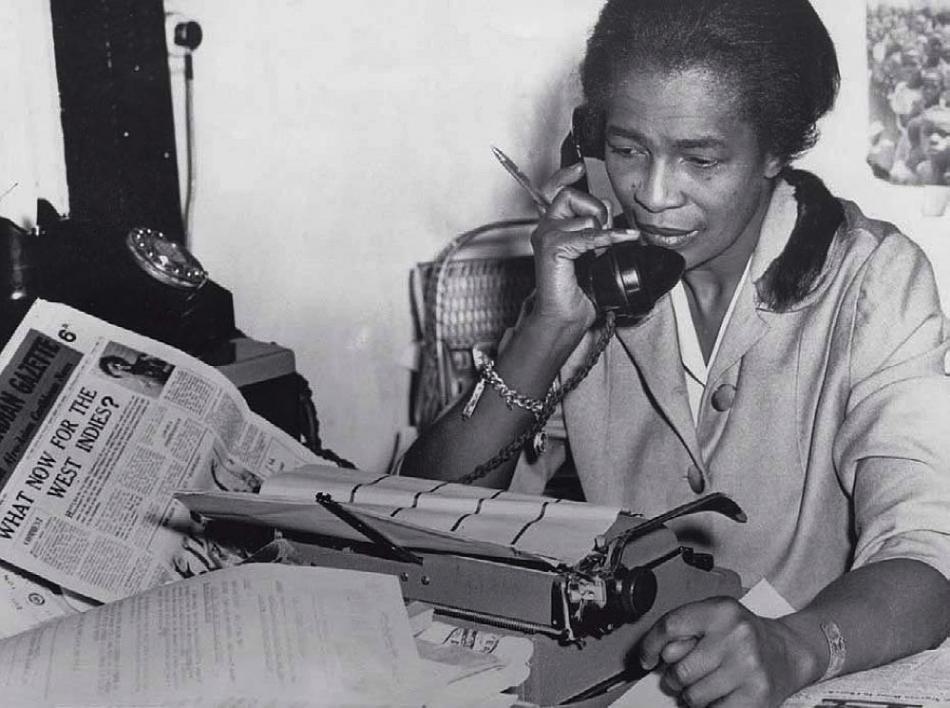
Claudia Jones was a revolutionary who devoted her life to the struggle against capitalism,
imperialism, and oppression. She was born in Belmont, Trinidad, in 1915, and moved with
her family to New York at eight years old. Growing up in Harlem during the Great
Depression, she experienced poverty and racism firsthand. These experiences and early
involvement in community organisations pushed her towards the revolutionary movement.
As a teenager, Jones was active in youth campaigns against racial discrimination. By her
early twenties she had joined the Communist Party USA as a writer and organiser. She
became a powerful Marxist voice against racism and sexism and played an essential role in
the Party’s campaigns around civil rights and workers’ struggles.
Jones published her essay “An End to the Neglect of the Problems of the Negro Woman!” in
the Party’s theoretical journal Political Affairs in 1949. There she discussed the concept of
the “triple oppression” of Black women, as workers, as women, and as Black people, and
insisted that their liberation was essential to the emancipation of the entire working class.
She applied Marxism in a way that encouraged fighting racism and sexism as a central part
of the socialist struggle.
Because of her communist beliefs, Claudia Jones was targeted by the U.S. state. After years
of repression and imprisonment during the McCarthy era, she was deported in 1955.
Following her imprisonment, in the UK she founded the West Indian Gazette, a communist
newspaper that became a platform for anti-colonial and anti-racist struggle. She was vital to
the establishment of the Caribbean carnival in London, helping shape it as a space for
community and expression.
Jones recognised capitalism, racism, and patriarchy as interconnected global systems that
could not be challenged separately. She connected the struggles of Black workers in Britain
with anti-colonial movements across Africa, Asia, and the Caribbean, situating them within
the broader fight for socialism. Her views were clear and uncompromising throughout her
life; true liberation could only come through the revolutionary overthrow of capitalism.
Claudia Jones’s activism was rooted in the struggles of the most oppressed, linking the fight
against racism, patriarchy, and exploitation to the broader struggle for socialism. She built a
community in Britain and fought tirelessly until her death in 1964. Her legacy lives on, to
honour her is to continue the fight for equality, socialism, and liberation.
Claudia Jones
—
by