
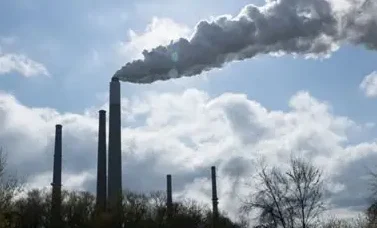
Climate change, species extinction, mass deforestation, poisoned soils and oceans – since the development of capitalism, the destruction of our planet and thus our basis of life has been advancing steadily. These big words are not abstract concepts, but are already destroying lives today. Extreme heat and drought, floods that sweep everything away, diseases caused by toxic fumes or contaminated water are already a reality for workers and oppressed people around the world. While capitalists build air-conditioned mansions in the remaining beautiful spots of the world, millions of people fight every day for their homes and survival because of the climate crisis and environmental destruction.
These ecological problems are not simply ‘man-made’, as is often claimed, but are the result of capitalism, the historical mode of production in which we currently find ourselves. In capitalism, a small class of people (the capitalists or the bourgeoisie) own the means of production. They own the factories and offices, they hold the patents and control the software without which nothing would work today. On the other side is the majority of the population, who have to work for the capitalists for a small wage, while the capitalists line their own pockets with the profits. The bourgeoisie is forced to make a profit – not simply because they are evil and greedy people, but because they will go under in the market if they cannot keep up with the competition. It is this necessity to make profit and grow that is also driving the destruction of the environment. The proper and safe disposal of toxic waste is much more expensive than simply dumping it into the river. You can’t make money from the rainforest, but cutting it down and building a huge plantation fills the coffers. If products are made in such a way that they break quickly and end up in the trash, more will be sold overall.
As early as the 19th century, Marx analysed that capitalism had created an irreparable rift in the metabolism between humans and the environment, one that cannot be closed within capitalism itself. We can imagine it like this: humans and the environment are in a kind of metabolic relationship with each other: in order to meet their needs for food, shelter, etc., humans change their environment. The change in the environment, in turn, has an impact on human life. For example, humans engage in agriculture to feed themselves. Depending on what is grown, the composition of nutrients, bacteria and soil structure changes, which influences what crops can be planted there in the coming years. In capitalism, human intervention in nature has become so intense and so extensive that nature cannot cope with it. Just think of the mountains of plastic floating in the ocean, or entire regions where huge monocultures have destroyed the soil to such an extent that nothing can be grown there anymore.
Theoretically, of course, states could reduce environmental destruction through strict regulations and laws, but they do not really do so. This is hardly surprising, since bourgeois states are not democratic representatives of the people’s interests, but rather the state rule of the bourgeoisie. Especially in the age of imperialist globalisation, it is child’s play for global monopolies to circumvent even the few existing environmental regulations and simply produce where it is easiest and most profitable for them.
It is therefore clear that the fight against environmental destruction means the fight against capitalism. The people we can and must win over to this fight against capitalism and for ecological demands are the workers and the oppressed. On the one hand, of course, because they have the power to bring down capitalism. But even without directly understanding the big picture between environmental destruction and capitalism, demands against bosses and against ecological destruction often go hand in hand. A factory that pollutes the environment first makes the workers sick who have to work with the toxins every day. A huge coal mine not only contributes to climate change, but also causes people to lose their homes. Life in the small flat into which a proletarian family has to squeeze because rents are too high and wages too low becomes unbearable during the next heatwave. The countless ways in which capitalism destroys the environment do not simply fall from the sky, but run through the lives and bodies of workers, providing starting points for joint struggles against capitalism and against the destruction of the environment. We call this understanding of the connection between work and the environment under capitalism the ecology of labour (emekoloji).
We oppose the inhumanity and destruction of capitalism with socialism, a system that enables us to produce according to people’s needs rather than the dictates of profit. Socialism will have the task of organising production in such a way that it closes the rift that capitalism has torn between humans and nature, by taking no more from nature than it can reproduce, and returning no more waste to it than it can absorb and process.
Seeing this perspective in socialism does not mean postponing the fight against environmental destruction to some indefinite future, but rather gives us the task of waging today’s struggles against the climate crisis and environmental destruction with the perspective of revolution and socialism. Those who truly believe in ‘system change, not climate change’ must organise for socialism today.