
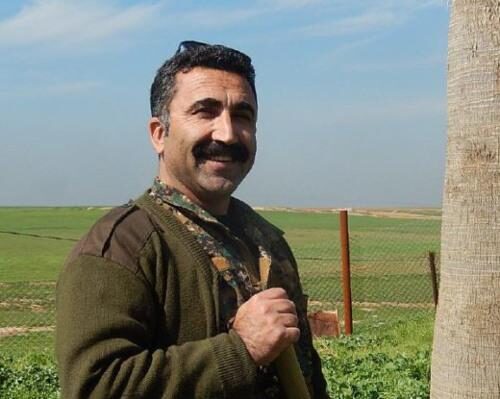
“We are the communist component of the Rojava revolution”
Here, we present an interview with Baran Serhad (Former central committee member of the MLKP who became immortal in 2019), a representative of the MLKP (Marxist Leninist Communist Party ), in which we talk about many topics such as the purpose of MLKP’s presence in Rojava, her programmatic and strategic perspectives in regards to the Rojava revolution, her position within Rojava’s military front, contributions that the MLKP brings to the women’s liberation struggle, and MLKP’s political and organizational work within the revolution.
Would you briefly summarize for us how the MLKP sees the Rojava revolution with respect to her programmatic and strategic understanding and what the goals of her participation to the revolution are?
In summary, I can say that since the beginning of her foundation, the MLKP stands as a party which embraces the Bakur (North) Kurdistan revolution, takes it as a crucial place in her strategy. It is a party which states that the country of Kurdistan has been colonized by imperialists and regional reactionary states; by defending this righteous cause and demands, she struggles for them. From this angle, the MLKP is from Kurdistan. Thus, our Kurdish people’s liberation struggle, based on “the right of self-determination and founding it’s own state” is one of the priorities of the MLKP. In our 3rd Congress held in Spring 2002, in the political atmosphere of that period, our party re-emphasized the rightfulness of the liberation struggles going on within the four parts of colonized Kurdistan. Correspondingly, our party included “the unification right of the four parts of Kurdistan” in her program. In the same congress, “the understanding of creating democratic or socialist federations of Balkan, Caucasian and Middle Eastern people” was also added to the program. The party emphasized the necessity of regional revolutions, and for this, the necessity of having regional alliances, coordination’s, and united forces.
This is an important decision since it indicates a widening of the horizon and of the opportunities of revolution. With this in mind, we started to consider many areas, from Balkans to the Caucuses and Middle East, more differently than before, tried to build connections with their existing struggles and considered the revolutionary potential of those lands on a different basis. Our 4th Congress consolidated the party’s will to apply these perspectives in a practical way and took various steps towards it.
When the Rojava revolution broke out, our party succeeded in adapting herself quickly with both as a force from Kurdistan and the perspective of regional revolutions. Our initial forces reached the area by August 2012, only days after the 19th of July, the date recorded as the beginning of the Rojava revolution. This was no coincidence; it reflects the commitment that we have to the region, especially to Kurdistan and every issue of the region is also in the agenda of our party.
What are the unique contributions that your party brought to the Rojava revolution, according to you? In other words, to which problems considering the development of the revolution has the MLKP brought solutions, thereby gaining her right to exist in Rojava?
Our party gained her right to exist in Rojava of course by joining the revolution, by defending and struggling to ensure its victory, by giving martyrs for this cause. She gained it not by cheering from a distance or standing in a supportive position; even though with limited numbers, by taking part in the ranks of the fight with her militants. Our very precious comrades were wounded or became martyrs on the frontlines to defend and develop the revolution. With a series of martyrs beginning with Serkan Tosun and growing with Sevda Çağdaş (Raperîn Dîcle); with the flag they raised and blood they shed, the comrades Coşkun İnce (Tekoşer Kurdistan) and Sinan Sağır (Suphî Garzan) whose body is still missing; and with our wounded comrades, whose numbers are 3 times higher than those martyred so far, we gained our right to exist. What makes our party belong to here is the martyrs whose blood mixed together and the comradeship of our fighters, who have been fighting day and night at the fronts of Serêkaniyê, Kobanê, Til Temir, Alya, Siluk, Minbic and Raqqa. With this opportunity, I would like to commemorate all of our fallen comrades with respect, loyalty and promise to make their dreams come true. They continue to be our reason for fighting and lead the way in our struggle.
In regards to the other aspect of your question, I want to point this out: in the early days of the revolution, we led our forces here with the idea that “every long march starts with a single step”. During this process, a certain level of quality and quantity came along after these first steps.
When our forces reached the area, the revolution had already begun, but still was in its very early stages. There was neither the YPG/YPJ nor the Asayiş (the popular police of Rojava). Together with the Kurdish Liberation movement, who is the vanguard of the revolution and strengthened by a strong comradely spirit we carried out mostly clandestine works.
By quickly taking on revolutionary duties, our forces had a role in solving the problems in their field of duty. They put in the effort to gather the daughters and sons of our people, who had not yet been involved in the revolution and to convince them of joining it. These recruits were organized in newly established brigades and afterwards other civil institutions.
Social duties in the fields of health and public security accompanied our military work. And shortly after, the women’s liberation struggle, media and commune building were added as well.
Our presence here led to both the entire forces of our party and the other revolutionary organizations from Turkey to focus their attention on Rojava. Through the efforts and the actual presence of our party, various Marxist and progressive forces from the world started to embrace the Rojava revolution more than ever.
Without a doubt, it was the Kobanê resistance that planted the Rojava revolution into the heart of the whole world, and turned it into a beacon of solidarity and hope. Just like the slogan, “with Arin and Sibel, we march to victory!” which our comrades chanted proudly, the barbarian ISIS gangs were defeated in Kobanê owing to the martyrs and the massive valors. Kobanê was already marching towards its own victory when some of the imperialist states brought military aid so as to share the victory. Despite all his prayers, that who knows how many times a day he is busy with, the conspiratorial attacks organized by the fascist Tayyip Erdoğan were fought off and Kobanê didn’t fall. His hysterical dream of “it is about to fall!” didn’t come true. This victory declared to the peoples of the world showed both the level of motivation of the peoples from Kurdistan and the ideological victory of honor and freedom struggle possible with the power of solidarity. ISIS and the Turkish state, Erdoğan’s AKP in particular, along with the other regional reactionary states who were supporting him were defeated. This is also the beginning of the process where ISIS began to retreat.
What I mean is along with defending, advancing and expanding the revolution on the ground, our party’s presence here made an important contribution to Rojavas visibility and popularity on the world stage. It helped to attract the attention of the laboring left, progressives and internationalists. Of course, because Rojava stands like a green oasis inside the realm of petro-dollar brutality and a political wasteland, the revolution was already showing itself off. The shine of YPG/YPJ against the darkness of ISIS is what we are talking about. Ours is a modest contribution, we would say. It is bringing the smiling faces of our comrades Sibel and Sevda next to Arin’s, or the ones of Sinan and Mazlum alongside Diyar Bagok’s. It is precious, historical and one of the most important values that makes us who we are.
Hereby, I would like to mention Şehid Ivana, our Avaşin, since she became one of the symbols of the revolution internationally. She made a significant contribution to the revolution with regard to attracting the attention of everyone; international comrades in particular, but also the mainstream media as well, and thus made it seen in the world press. As a warm-hearted guerrilla, she drew the attention of many socialists and progressive peoples from Europe and around world, to come and join the struggle. Again in the same period, we developed our relations with many European progressive organizations, such as groups from Switzerland, Germany, Greece, Spain etc. and they played their role within their countries by being the friends and comrades of our revolution.
As last words on this issue, I can add: due to the fact that the revolution had considerably succeeded in Rojava, our forces also increased their focus on the social organization apart from just the field of defense. On this basis, we have been giving support and working to expand the campaigns of “Ez Naçim” (“I don’t leave”) and “Komünlerde Örgütlen, Federasyona Sahip Çık” (“Organize in Communes, Embrace the Federation”). Likewise, against the ENKS-like (the organization on Barzani line in Rojava) reactionary forces, which aim to hit the revolution from inside, we carry out ideological and political works by enlightening our peoples and organizing them in the revolutionary institutions.
How do you evaluate recent operations that your party was involved in? In which attacks, with what kind of approaches have you participated so far? What is the purpose of those attacks with respect to the development of the Rojava revolution? Do you participate in all attacks or do you have particular priorities?
In the beginning stages of the revolution, our forces belonged to different battalions and quarters in which they were participating in both the attacks and the establishment processes of the revolution. In that sense, we have played a part in the attacks and operations of Til Hemis, Cez’a, Sere-kani, Til Koçer, Girê Ziro, Tirbespiyê, Hasekê, Til Temir, Amûdê, Ebu Rasin, Mebruka. Likewise, we played a part in the first supporting squads that reached Şengal right after ISIS had invaded and carried out a massacre there. Later on, we announced the foundation of our Şehit Serkan Battalion, having the name of our first martyred comrade in Rojava. Since then, we have been participating in attacks as a part of this battalion. A short time after, we established the International Freedom Battalion (IFB) with the participation of organizations from Turkey and Europe, such as TKP-ML, BÖG, and MLSPB-DC from Turkey, RC* from Spain, and revolutionaries from Greece. Right after its establishment, IFB participated in the Siluk-Girê Sipî attack. There, our comrade Halil Aksakal (Mazlum Aktaş) was martyred. In that attack, our trench comrades from BÖG and MLSPB-DC fell martyr and joined to be part of our immortals. I would like to commemorate them with respect, in the names of comrades Alper, Cemre and Doğan.
(*TKP-ML: Communist Party of Turkey – Marxist-Leninist, BÖG: United Freedom Forces, MLSPB-DC: Marxist-Leninist Armed Propaganda Units-Revolution Front, RC: Reconstruccion Communista now : Partido Marxista-Leninista (Reconstrucción Comunista))
As the Şehid Serkan Battalion and the IFB, we participated in almost all the operations in the cantons of Cizîrê and Kobanê. The IFB is a mobile battalion, so apart from some short periods, it is always at the frontlines. The Şehid Serkan Battalion, on the other hand, takes part in the attacks sometimes as teams, other times as squads, rather than as a full battalion.
What concerns the Rojava revolution, also concerns us. Therefore, we have been and continue to be in the attacks and operations of Hol, Minbic or Raqqa. Our perspective is this: With our communist and Kurdish identity, we count the Rojava revolution as our revolution. For this reason, we care about all attacks with the purpose of securing the revolution. In that sense, when we joined the Minbic fight, where we lost our comrade Raperîn to immortality, we were doing it for the sake of securing the revolution through uniting our cantons. In that attack, Four of our comrades were wounded two of them seriously. But with the liberation of Minbic, a strategically important foothold was gained.
Today, if we speak about the occupation of Cerablus by the fascist Turkish state, the main reason behind this is quite obvious: to block the way of our revolution moving towards Efrîn from Minbic, to stop the progress of our revolution. They don’t want us to unite our cantons and end the division of Rojava that was splintered through the politics of colonialists under the name of the Arabic Belt. They seemed to have succeed in this for now in the exchange for the price of tens of Turkish soldiers’ life, but this is only temporary. Tayyip Erdoğan has already started to prepare for running away from Al Bab. From Cerablus to Bab, the Turkish state is at a standstill and this situation points the way for new developments.
Because of our regional revolution perspective, we are also taking part in the attacks to liberate Raqqa, which was captured by ISIS and transformed into its main base. Those are Arabic lands and yes, there are a range of duties that fall to the Rojava revolution for building a more democratic and libertarian life in Syria together with the Arabic workers. As one of the components of the revolution, we act in accordance to this role.
We can say that, as the attacks continue to secure, improve and expand the revolution, the liberated regions, on the other hand, are becoming stronger both in an ideological and military sense. These attacks are also an opportunity to acquire significant experience and trench comradeship.
In these lands, where historical prejudices and bigotry continue to exist, they develop the fraternity, and the consciousness of a common life together with Kurdish, Arabic and Suryani peoples. They help to clean off the dirt and the rust of colonialism, feudalism and capitalism. Likewise, in this patriarchal Middle Eastern land, via YPJ’s woman warriors and commanders, they bring a new kind of will which one by one, breaks up the ingrained ideas claiming that war, braveness, arms, etc. are particular to men alone. They bring an ideologically fresh breath to these lands and with the wind siding along women, the dirty and dark atmosphere of this period of history is being swept away. This is a new and very precious situation for the Arabic lands.
Although your military presence is more visible, we see that you carry out political works and campaigns amongst the masses in Rojava. What are your aims in your political mass work? And in addition to this, as communists from Kurdistan, what are your organizational perspectives within Rojava and Kurdistan?
Our party has a Rojava organization. The organization resulted from us being a Kurdish party and working in Rojava. Looking from an organizational point, this Rojava organization is directly dependent on our MLKP/Kurdistan organization. Getting organized within all four parts of Kurdistan, which were colonized and splintered by imperialists and colonialists, and strengthening the liberation struggle in these parts with a socialist-patriotic perspective simply means following our party line as our right and also our duty. Considering the developments in Rojava, our 5th Congress took various decisions in regards to expanding our organizing efforts in Kurdistan. By considering the needs and opportunities of the revolution happening in Rojava, the Congress determined some political and organizational duties.
Most of our work here covers the defensive duties, however we politically organize both within the revolution’s institutions and masses. One of our primary goals is defending the revolution, deepening the revolutionary process and elevating the revolutionary consciousness of the masses here. It is true, what is happening in Rojava is a revolution, but it is not completed in all senses. Rojava is surrounded by imperialists, regional reactionary states, as well as parties and organizations following KDP’s bourgeois and collaborative political line. The masses are bound to be wary and their confidence is suppressed by poverty, explosions and embargoes. We need to ensure people embrace the revolution further and improve their sense of belonging [to the revolution] , that are the duties of our party.
Sometimes it is not understood well enough but Rojava is under a total siege. One side is besieged by the Turkish state with walls, barbed wire, soldiers and tanks. On the other sides, there are ISIS and the other mercenary’s of Turkey, the Barzani forces, who are trying to ‘discipline’ us with hunger and poverty by closing Sêmelka, the only border gate to Iraq. Apart from Efrîn, no border relation is left with the Syrian regime. So far the regime couldn’t manage to restrain the revolution, but as they are historically colonialists with their mentality shaped by Arab nationalism, we can assume that they will try to strangle the revolution at the first opportunity they have.
Under such a siege, it is crucial for the revolution to gain people politically and ideologically. Thus, we give priority and support to the campaigns of “Ez Naçim” and “Di Komînan de xwe Rêxistin Bike, Ji Fîderasyonê Xwedî Derkeve” (“Organize in Communes, Embrace the Federation”). Through those campaigns, we develop an attitude against the migration politics to Europe, branded as a “journey to hope” for totally ideological purposes, and instead we state that ‘in Rojava there is hope’. Moreover, together with our friends coming to join the revolution from Europe, we reveal the imperialist lies to our peoples.
The socialist patriotic manner is a very genuine characteristic of our party. That is to say, we see ourselves as the communist component of the revolution, vanguards of the socialist struggle. We are trying to integrate our national democratic liberation struggle with a socialist perspective. According to our view, Socialism needs to be integrated with the Rojava revolution and we make propaganda of this thought while embracing the existing revolution all together, because we think that liberation of the whole region can only be possible through socialism. In every field that we carry out our struggle in, we try to lay a foundation for this perspective to be realized. Socialism or socialist patriotism is not a self-evident character. It requires the positioning with a socialist patriotic perspective on the side of laborers, workers, women and the oppressed and poor people. It requires building up alliances to realize your perspective as well as organizing the basic forces of the revolution along the way to achieve the consciousness of this perspective. This is what we’re trying to do, as much as we can.
The political and organizational ways of these lands just don’t fit with the ones of Turkey, not even with North Kurdistan. Therefore, the norms for here need to be different than the other ones. Here in Rojava, we can talk about quite distinctive aspects. Before anything else, we are organizing within the revolution; as we are part of it, we are trying to make the movement more socialist. But before all this, this revolution needs to be secured, that is, all those risks that I have just mentioned have to be eliminated. This cannot be done by ranting from outside, well, more specifically, from computer screens, but instead by actually joining the revolution, through shedding blood for the cause. This is the only way for your words and commitment to be seen and to carry a weight with our peoples. What lays behind the respectability of our party in these lands is our effort to have this commitment.
It is known that you have set up your second battalion in Rojava. What is the mission of Şehit Sarya Battalion?
The Şehit Sarya Battalion has actually already been established but was only publicly announced on 12th of December, the date our comrade Sibel Bulut (Sarya Özgür) became immortal. It is an academy for women soldiers. In this battalion, new fighters, both outside and from different parts of Rojava, come to receive military and ideological training. With this battalion, we also aim to provide a mean for young Kurdish, Arabic, Suryani women from Rojava to join and defend the revolution. Still within the YPG system, but uniquely organized, the battalion has so far trained youth who want to defend the revolution, to improve themselves militarily and ideologically, internationalist fighters and young women from Rojava. From now on, we aim to continue this work with new local and general members.
What about the International Freedom Battalion? What are your expectations from it for the future?
The International Freedom Battalion is an important part of this revolution. During early 2017, it has been attacked by ISIS three times, but just as they had written in huge letters on the ramparts of the school they used as a base: “NO PASARAN”, these gangs could not pass. I mentioned the founding parties before; right now, the battalion consists of the forces from BÖG, TİKKO and MLKP, together with the international soldiers from different countries. With the revolutionary practice put forth in several attacks, with its martyrs and wounded comrades, the battalion gained a respected place in the area. During an attack which happened on the 9th of January, the battalion inflicted a heavy blow to ISIS gangs. Sixteen bodies of the gangs were counted after a fight inside the same building. Comrade Doğan Kırefe from BÖG was martyred and two of our party’s soldiers were wounded. The gangs received the severest blow in that area and therefore now, with new ambushes, they are trying to invigorate their forces. However, we keep on saying “no pasaran”!
We want the IFB to be a window of the Rojava revolution to the whole world. Such a battalion, which consists of women and men from various nations, would definitely give strong messages to the people of the world. Until now, the participation to the battalion in terms of quantity, has not met our expectations. I regret to say, but in this aspect, the world’s leftist and socialist movements fell well behind the ISIS gangs, despite the fact that this is a revolution which aims to develop an egalitarian and libertarian relationship among peoples without being stuck in narrow-minded nationalism, and above all, it represents the light against the reactionary barbarianism symbolized under the name of ISIS.
The fact that the USA, France or any other imperialist powers have been forced, for the sake of their own interests, to begin military operations against ISIS, even though ISIS is the proxy of their NATO ally Turkey, doesn’t extinguish the features of the revolution. Whether there are US or other coalition forces or not, Minbic would still have been entered, or Raqqa would still have been liberated at some point, both would have been retaken anyway. Because ISIS is the biggest threat to Rojava, so far, thousands of our martyrs and wounded comrades were not lost during a war against the Syrian government or with other regional reactionary states. Our main fight is against ISIS, so yes, while we are fighting with them, the jets or drones of the imperialists are not yet an issue, because it is in their own interests, to carry out strikes against ISIS. We consider this a mandatory and temporary tactical military relation, while both knowing and preparing ourselves for one day that those jets might come to hit us too.
It is understandable that some of our friends, whose words and actions stand by the revolution, have some worries concerning the possible intentions of the imperialists. Yes, we are talking about imperialists here and indeed they do not ‘help’ because of their sympathy for Kurds or Arabs. They have their own interests, which just happened to match with those of the Kurds for a short time now. The imperialists have both ideological and political problems with the existing revolutionary leadership and the will that leads it; and these are not that kind of problems which can be overcome by a bunch of tactical military collaboration or jet sorties. Weakening the revolution, making it dependent on their economic aid, making it follow their line; these are their objectives. But they have not met their objectives: if this revolution were led by Barzani and his capitalist, collaborationist ‘answer’ for the Kurds, then Rojava would have already been recognized internationally. We believe that one should talk in the light of these truths and carry the responsibility of these words. That is what is expected from progressive and revolutionary forces.
And besides, so far I’ve not heard of any “leftist” jet that has been stopped from striking ISIS. No one should have any doubt that we would prevent any of those from hitting ISIS and its supporter the Turkish State with bullets or rockets, or forget those, even with a stone. There is no one standing in the way of those willing to fight, to struggle, to raise the anti-imperialist flag; either here or wherever they are!
For us, internationalist comrades coming here from their own individual initiative in order to do something for the revolution are a thousand times more precious than the chatterers talking. With this chance, I would like to greet and commemorate all those international warriors that evaluated the revolution and the process correctly and turned their faces towards Rojava, came and fought, were martyred, wounded, or arrested. We salute them.
To what extent do you participate in the management of the economical and political life in the assemblies or other sorts of political structures? What is the mission that you have undertaken in these areas? To which problems have you brought solutions or are aiming to do so?
In Rojava, there is an organized life in regard to economy and politics. There are various organizations established in every field of life; autonomous canton administration, Tev-Dem, Kongra-Star, assemblies, communes, workers’ unions, etc. Within all these organizations and parallel to them, there are women organizations as equals. We cannot say that all of these are playing their optimum role or working perfectly but it’s certain that there are lots of organizations through which people, and women especially, are able to defend their rights or express themselves in many ways. As a part and cadre of the revolution, even though our forces are limited, we carry out different works to make these organizations functional, to make them play their roles and be embraced by the masses.
There are communist representatives within some decision-making institutions at cantonal level, as well as in cantonal assemblies and units dealing with the organizational works. Likewise in the other various platforms, we, as communists, discuss our opinions and make proposals.
That’s what is important, bringing up views and suggestions about the processes and submitting these to the masses from a socialist perspective. It is something what we are trying to achieve. Communist cadres working in various institutions, making their suggestions the agenda of the institutions which they are part of and lifting these suggestions to decision level. Again, some campaigns and ideas already became topics and have been made duties for the institutions and then had to be embraced by the masses. The campaigns I’ve just mentioned were like that for example.
While these are mainly organized by communists, they are also supported and practiced by the other parties and organizations gathered there. Distributing communiques together, organizing panels, institutional visits, mass meetings, graffiti’s and poster hanging are all being carried out collectively, with as many groups and parties as we can include. Meetings are held in the communes. We propose daily life issues of workers and also political issues of the revolution for the agenda. We are struggling against some cases of ideological degeneration, we are making suggestions to expand the women’s revolution. For example, recently, a campaign for the masses to understand the federal system had been adopted at the level of the cantonal decision making bodies and the need for an overall campaign was accepted. So now, a campaign about this issue is going on across all cantons. Furthermore, while we have been developing different suggestions to reduce the discontent caused by the crisis of sugar and gas shortages, we kept on distributing communiques revealing the ENKS and KDP reactionaries, who contribute to some of those crises, and through this, we played an important role in reaching to a general decision on organizing mass demonstrations. While we do carry out discussions about fighting off bureaucratization, we also try to increase steps for institutional opportunities which will play a bridging role between the peoples, at least as much as our current capacity lets us.
Being in a position that evaluates issues with a socialist patriotic perspective allows us to make objective considerations about the vanguard forces of the revolution. Although we try to defend the position of ourselves as “the conscience of the revolution”, unfortunately we haven’t achieved an acceptable quantity of forces so far. Still, our efforts continue.
Even though it is possible to consider and discuss several issues concerning the progress of the revolution such as economic problems, peoples’ needs, women’s rights and their freedom or the rights of children, nature and animals etc., some issues become a sort of a luxury under this political climate. Under conditions in which both war and embargo continue, as well as ISIS and its governmental friends in Turkey carrying out every kind of attack to attempt to strangle the revolution, we prioritize our attentions on securing and advancing the revolution, along with what we gained so far.
In respect to easing the embargo’s weight, there is no need to make an extra emphasis on how fertile Rojavas land is. So, as well as giving practical suggestions, we discuss and make efforts to increase the possibilities of striving collectively for issues like increasing the agricultural productivity, making it a duty to enlighten the masses, making the revolution internationally known and increasing solidarity, fighting ideologically and legally against war opportunists and so on.
Rising also as a “women’s revolution”, how does the Rojava revolution improve women’s liberation struggle at this level? Which social and political perspectives, what kind of means does the women’s revolution advance with? What kind of role does the Party’s KKÖ (Communist Women’s Organization) play?
Above all, in this patriarchal Middle Eastern land, it is just an honor for everyone to be part of a revolution which argues for a women’s army, women’s will, equal representation, co-chairmanship, women’s police force, women’s communes, women’s courts and hundreds of articles of law siding with women. These alone are enough to express what kind of a revolution is happening here in Rojava! The primary field that gives both democratic and libertarian character to our revolution is the field of women liberation. It is true that there are still some serious problems existing in practical terms. Women still have to fight and pay attention within areas like culture, daily life and politics due to five thousand years of male supremacy. However the existing rights and freedoms, and how they are embraced by women here cannot even be compared with those in any other country. We cannot use patriarchal capitalist countries as a comparison for here, as in many ways we have already surpassed them. The bar cannot drop below the main acquisitions of women’s liberation struggle and socialism. Of course, including the communist women, the women who build the Rojava revolution won’t let it happen.
The communist women, with their limited forces, are trying to extend our KKÖ’s perspectives among women. Our woman comrades are quite active with their analysis and proposals about campaigns or planning, as well as the organization of special days like 8th of March or 25th of November. Before, we had carried out duties in Mala-Jin (Women’s House, women-only places in each neighborhood), founding a women’s press, and now we carry out works in women’s communes and umbrella organizations. This foundation of female solidarity set us in good steed to do organizational and educational work among young women and domestic laborers. Then we could advance the women’s revolution together with them.
I can state the recent developments in this regard as such: in the social contract of the Democratic Federal System of Northern Syria, which has been subjected to significant debates, the voice of women is reflected on a large scale. During both the preparation process and the negotiation phase, it was the women whom were most active. The “Co-chairmanship practice” was brought to the federal system. Likewise egalitarian laws siding with women were secured by the federation.
All these are the expressions of the gains of Rojavas women’s revolution and how they are directly reflected on the federal system and extended towards the region.
Our duties therefore include making proposals and mobilizing a mass basis for these proposals, concerning issues like the education of the whole society, and of men in particular, deepening the legal level of the revolution which was gained so far, and spreading this to the whole world by developing women’s alliances both regionally and internationally.
In what aspects has the experience of the Rojava revolution improved and enriched your party’s theoretical and political understanding? What kind of effects and contributions has this experience brought to the communists of Kurdistan, the ones of Turkey, international fighters and organizations that support the revolution?
Well, I’m not sure if I would be able to answer them all. But first of all, the Rojava revolution allowed us to widen our revolutionary horizon and to gain some concrete experiences arising from being inside an actual revolution. We have experienced all the developments which were encountered in every country that made their revolution, such as the masses’ filling streets, seizing the government agencies, dual power situations, people taking up arms, women becoming half of the revolution, militarization, being besieged, embargo’s etc. And we have been equipped with those experiences in a very particular way in Rojava Kurdistan.
Here, under the conditions in which masses of workers and a working class movement are absent in a classical term, there is a guerrilla leadership instead, the liberation of the historically colonized country of Rojava, Kurdistan by seizing upon an emerged opportunity with a choice of a “third way” so to say is a quite instructive experience. In the case of reading certain historical developments correctly and developing correct tactics, you can create a big leap with a limited force and turn this situation into a revolution, it all depends on the existence of prepared organized forces. This is one of the significant points that the revolution taught us.
It is also important to emphasize one of the issues of this strategy, the phenomenon of “indirect reserves” in the context of what Rojavas practice has taught us. It becomes quite concrete here in Rojava to make use of the objective opportunities arising from governing crisis of imperialist and reactionary states correctly. Utilizing the conflicts and contradictions among sovereigns for revolutionary purposes has showed not only the possibility of a revolutionary subject growing by leaps and ruptures but also doing politics without being in a reserve force position for the imperialists. By benefiting from these conflicts and contradictions and making tactical maneuvers, the revolution has both gained strength and also been emancipated from the besieged conditions.
Claims about the inevitablity of religious and national wars which the imperialist and capitalist barbarism theorizes under the name of “civilization wars”, are replied by the practice of federation and cantons that raise the unity and solidarity of peoples in Rojava. What is trying to be achieved here in Rojava, where the people get organized in assemblies, united in communes and thus create the conditions of direct democracy through their grassroots organizations, is bringing theory to practice, putting flesh on the bones of it by action.
Lastly, what kind of a call regarding the Rojava revolution would you like to make to our peoples?
Rojava is a revolution of rising hope against the despair of colonialism, racism and sectarian politics. In this smothered blood and cruelty, Rojava is where our peoples can get a breath of fresh air. It is egalitarian, libertarian. Although it is far from completed, what it has accomplished so far has already taken its share in this stage of history.
Come here, embrace and join the revolution. Struggle with us to turn this revolution into the socialist front of the 21st century.
This revolution belongs to the peoples. It belongs to those who are oppressed and yes, most of all it belongs to women. Do something for it. Give political, material and spiritual support to this revolution!
Rojava is a beautiful place for those who are willing to be purified from the rust and dirt of the imperialist capitalist world. It is a humble spring of joy for humanity.
Here we have a revolution for all those willing to be emancipated from wage slavery, which they can call their own. No matter how much we tell, how much we are proud of, it won’t be enough. Let’s finish the interview by saying come and reach the honor of being a part of this revolution and let’s better say the last words in our own language:
Bijî têkoşîna rûmet û azadîyê! Bijî Şoreşa Rojava!
(Long live the struggle of freedom and honor! Long live the Rojava Revolution!)