
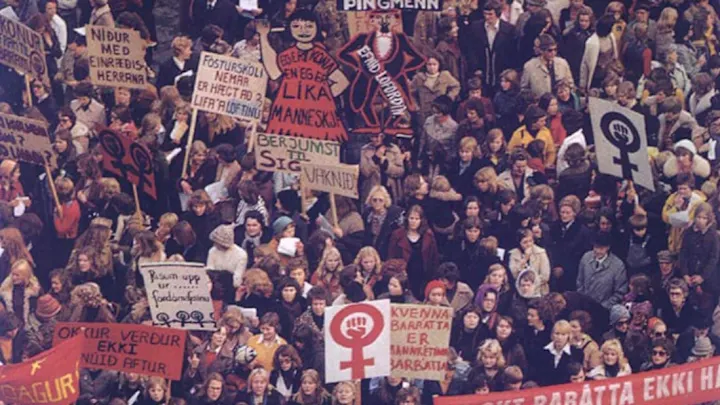
What is a women’s strike?
A women’s strike is a right won through centuries of women’s struggles. It is the will to stop the entirety of life. It is a strike launched against the patriarchal system; it is not anti-men, not anti-class, and not an action against individual men. It is a form of withdrawing labour against a system of exploitation in which patriarchy and capital are intertwined.
Today, we are living in a historical moment that has led more women to participate in women’s strikes and women’s struggles. We are in a period in which women, by developing gender consciousness, have become a material force in their own right at an unprecedented level.
Before the era of imperialist globalisation, there was a certain balance between the widespread use of women’s labour and domestic servitude within the structure of the modern bourgeois family. Women were both at home and in the workforce, yet this dual role was maintained within a particular equilibrium.
In the period of imperialist globalisation, this balance was disrupted. A new era began—one that fragmented the bourgeois family, pushed it into crisis, and socialised women’s labour on a scale never seen before. Capital and production needed women’s labour more than ever, and at the same time could exploit it as a much cheaper workforce compared to men. This process deepened gender contradictions in every dimension.
Women entered the labour market in more massive numbers, under flexible working conditions and in the most exploitative forms of employment. Women participated more in production while simultaneously becoming more precarious. This reality naturally strengthened the women’s movement. As women became more involved in social production, they reached a more advanced awareness of their own exploitation.
One of the most visible developments of this century has been women’s struggles. Women’s strikes represent a qualitative leap within that struggle. They reflect a deeper consciousness of the conditions of exploitation both at home and in social production. They declare: “Just as I have labour in the factory, I also have labour at home—I have labour in every sphere.”
The Historical Background of the Women’s Strike
The women’s strike has been a tool of struggle for centuries.
It is as old as Lysistrata, written in 411 BCE, which tells the story of women organising a sex strike to stop the war between Sparta and Athens.
In the modern era, one of the first concrete steps was March 8, 1857. Forty thousand textile women workers went on strike demanding the reduction of the 16-hour workday to 10 hours, higher wages, better working conditions, and equal rights. The strike ended with the massacre of 120 women.
In Tsarist Russia, on 8 March (23 February in the Julian calendar then in use), peasant women, soldiers’ wives, and women workers in the armaments factories in St Petersburg went on strike and triggered the February Revolution through their protest — an uprising that laid the basis for the October Revolution and the birth of the first socialist state.
In Turkey and Kurdistan, the first women’s strike took place on August 22, 1876, led by women workers at the Feshane factory, who demanded the payment of their unpaid wages.
On September 26, 2006, 81 women workers launched a strike that lasted 448 days, protesting practices such as employers scheduling pregnancies and ignoring needs related to menstruation.
In the 1970s, there were debates and initiatives around strikes centred on domestic labour.
Germany’s first general strike, the “Weberinnenstreik,” was a women’s strike. Austria’s first general strike was also led by women.
However, women’s strikes experienced their biggest leap between 2015 and 2017, gaining an international character.
In Poland, women went on strike on October 3, 2016, against a total ban on abortion.
In Argentina, following the murder of 16-year-old Lucía Pérez, women organised a nationwide one-hour strike on October 19, 2016. Argentine women then called to welcome March 8, 2017, with a women’s strike.
In the United States, a women’s strike was organised against the misogynistic, anti-immigrant, racist Trump administration.
Why and How Does a Women’s Strike Happen?
“Is a women’s strike possible?” is a frequently asked question.
A strike is the use of the power that comes from production. When workers stop production, it is the outward expression of the contradiction between the bourgeoisie and the proletariat. When women stop production, it is the outward expression of the contradiction between women and both capital and the patriarchal system.
A women’s strike reveals both the contradiction between women’s labour and capital and the contradiction between genders.
When women withdraw from production:
- The level of women’s participation in social production becomes visible.
- The gendered division of labour is exposed, particularly in fields most immediately affected—education, healthcare, cleaning, textiles. It becomes clear that many of society’s essential needs rest upon women’s labour.
- Domestic production becomes visible.
As Cecilia Palmeiro from the Ni Una Menos movement stated:
“Just as we sustain the capitalist economy with our labour that is devalued in the market and unrecognised at home, we can also bring it down.”
Forms of Labour Targeted by the Strike
A women’s strike encompasses all forms of women’s labour:
- Wage labour
- Domestic labour
- Domestic servitude
- Sexual services inside and outside the home
Women workers continue to constitute the leading social force within women’s struggles.
Forms of Action in Women’s Strikes
Women’s strikes include various forms of action:
- General strike: stopping production and services both at workplaces and at home
- One- or two-hour work stoppages
- Going on strike from the moment wage inequality begins (when men continue to be paid but women effectively work unpaid)
- Stopping work at a certain hour and “freezing” in place
- Refusing domestic labour
- Boycotts against sexism
- Consumer strikes
- Blocking streets and roads
- Marches, strike vigils, demonstrations
- The use of symbols and colours
The women’s strike is crucial for making visible the labour spent on care work and domestic work, often framed as acts of “love.”
One of the places where life would stop when women withdraw their labour is the “private home,” where the family is constructed. Domestic labour, rooted in women’s domestic servitude, remains both a theoretical and practical central issue of women’s liberation struggles in the 21st century.
Therefore, on International Women’s day:
Let us not cook, not clean, not iron, not take on childcare, elder care, or care for the sick, not shop. Let us stop performing the domestic and care work that has worn down women’s lives.
How Can the Women’s Strike Spread?
As seen especially in Spain and Switzerland, the key lies in building widespread, local, and flexible forms of organisation.
No political idea comes to life without organisation. Strike committees and commissions must be established at the local level. A women’s strike must not be limited to workplaces; it must take place in every sphere where women exist and produce.
The aim is clear: to show what happens when women withdraw from life. This reminds the capitalist state, employers, and patriarchal authority within the home of the value of women’s labour.
The Role of Men
A women’s strike is not just any strike; therefore, not demanding men’s participation is a fundamental principle. The central debate concerns the position of trade unions and existing labour laws. It is possible for unions with a majority of women members to call for a strike specifically for women members.
Concrete Gains
Women’s strikes have produced results:
In Iceland, equal pay for equal work was legislated.
In Poland, the abortion ban was withdrawn.
In Argentina, a program addressing violence against women was adopted.
In Ireland, the abortion ban was lifted.
In India, the demands of domestic workers were accepted.
In Chile, constitutional reforms expanded abortion rights.
One of the sources of strength in women’s struggles is learning from one another. Even the smallest gain for women anywhere in the world is seen as a gain for all women and transformed into collective power.
Recent years have shown us that a women’s strike is possible.
With March 8 so close, and with widespread calls for women’s strikes across Europe, we call on all young women to join the women’s strike, to stop life, and to take to the streets for every one of our sisters.
Let us roll up our sleeves.
Let us stop life.
Long live our women’s struggle.
Long live women’s solidarity.
Long live the women’s strike.